
How to Use a Workout Plan Effectively
A Good Workout Plan Does Not Happen by Accident
Many lifters think that creating a workout plan simply means choosing a few favorite exercises, deciding on the number of sets and repetitions, and starting to train.
In reality, creating an effective workout plan is much more complex.
It requires knowledge of training principles, practical experience, and the ability to adjust the plan to a specific person, their goals, performance level, and recovery capacity.
It is not something that can be learned simply by watching a few videos or reading a few articles.
What If You Are Just Starting Training?
If you do not have enough experience yet, it is a good idea to follow proven workout plans or work with an experienced coach.
Quality training plans are usually designed with logical progression, appropriate training volume, and a suitable exercise order.
Over time, you can adjust them based on your own experience, but the foundation should always come from a proven system.
A Workout Plan Is a Starting Point
A workout plan alone does not guarantee results.
It is a framework that guides your training process.
However, real training situations can require adjustments.
A busy machine, health limitations, lack of equipment, or other circumstances may mean replacing an exercise or temporarily skipping it.
This is a normal part of the training process.
The Same Applies to Repetitions
The same principle applies to planned repetitions.
If your workout plan includes ten repetitions, it does not mean you must complete exactly ten at all costs.
If you train with proper effort, appropriate intensity, and suitable weight, you may complete only eight or nine repetitions.
On another day, you may complete more.
That is why it is called a plan.
The actual workout may be slightly different, and recording what really happened is what provides valuable information.
Why Is It Important to Record Your Actual Workout?
The difference between your planned workout and what you actually completed provides valuable feedback.
It shows what worked as expected, what was too challenging, and what may need to be adjusted in future training cycles.
This information helps you improve your workout plan over time instead of relying on guesswork.
Recording your real performance allows you to make informed decisions based on experience rather than assumptions.
How Does a Digital Workout Tracker Help?
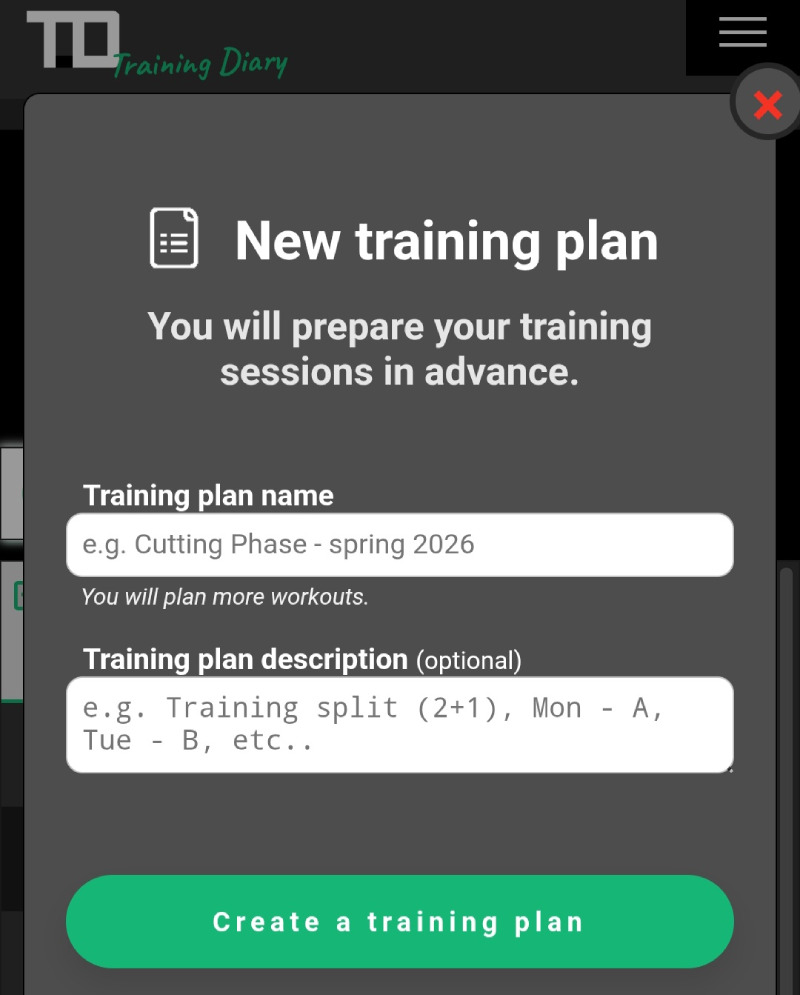
The digital Training Diary allows users to easily create Training Plans and then add individual workouts to them.
During training, you can adjust exercises when necessary, record the actual number of repetitions, the weights you used, and any important notes.
This allows you to preserve both your original workout plan and the real outcome of every training session.
Over time, your workout history becomes a valuable source of information that helps you train more effectively.
Conclusion
A quality workout plan is built on knowledge, experience, and a systematic approach.
A workout log does not replace your training plan.
Instead, it helps you follow your plan consistently, record what actually happened during each workout, and build a training history that supports better decisions in the future.
The combination of a structured workout plan and consistent workout tracking is one of the most effective ways to achieve long-term strength and fitness progress.
More info articles
- What Is a Workout Log and Why Should You Track Your Workouts?
- Paper or Digital Workout Log: Which One Is Better?
- How to Keep a Workout Log the Right Way
- Why Track Weight, Sets, and Reps in Your Workouts?
- How to Track Your Progress in Strength Training
- Common Workout Logging Mistakes and How to Avoid Them
- Why Should You Plan Your Workouts in Advance?
- Progressive Overload in Strength Training
- How to Stay Motivated to Work Out Long Term